
Data collection
The innovative federated machine learning approach proposed for patient health monitoring and disease prediction. Advanced healthcare framework comprises multiple interconnected stages:
-
Data Collection: It has a specific layer for gathering patient information.
-
Data Preprocessing: Raw data processing at various places from the raw to the state, which is ready to be analyzed.
-
Local Model Training: Models are to be trained with updating localized data.
-
Edge Cloud Storage: Private edge cloud infrastructure storage of the centralized federated model.
-
Public Cloud Integration: It is a better integration and sharing of resources.
-
Validation: This is the final validation to check the correctness and accuracy of the predictions.
For instance, health information can be integrated with health platform data so that it is presented through accurate and personalized health insights.
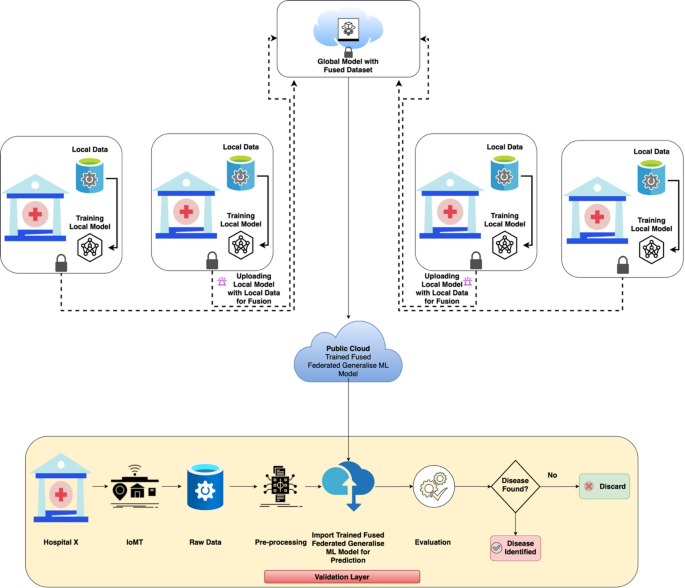
The federated health care system, in the proposal, adopts a collaborative approach to disease prediction. It has a core model residing in a secure private edge cloud, communicating with multiple local models dispersed over different health facilities as shown in Fig. 1 (A Fused Federated Learning-based Healthcare Monitoring System).
This architecture can facilitate a cycle of learning:
-
The global model broadcasts its aggregated weights to individual hospital-based models.
-
Local models at each node, denoted by letters A to N for hospitals, update their predictions on such shared weights of common learnable parameters with their patient-specific data.
-
This process is repeated until performance requirements are satisfied.
Each participating hospital maintains the patient-specific data of its service area in its private database. The system uses the above-decentralized data structure to add predictive accuracy with patient-privacy-friendly. For this purpose, the private edge cloud plays a critical role in that.
-
Holding the international model.
-
Facilitating the training and retraining of local models.
-
Serving as a safe intermediary for weight-sharing.
The proposed methodology consists of several integrated layers, each systematically designed to facilitate secure, decentralized patient monitoring and disease prediction using federated learning combined with data fusion techniques.
Initially, in the Data Collection Layer, diverse IoMT-based medical sensors and wearable devices are deployed across multiple healthcare institutions. These instruments gather continuous, real-time medical data such as vital signs, medical imaging, lab results, and patient demographics. Data collection at this stage is localized and institution-specific ensuring privacy and adherence to compliance standards. The heterogeneous nature of this data provides a comprehensive view of the patient’s health status and allows for more accurate disease prediction.
Data preprocessing
Following data acquisition, the raw data passes through the Data Preprocessing Layer, which is a crucial step to ensure data quality, consistency, and compatibility. In this layer, the raw data undergoes various preprocessing operations such as normalization, cleaning (removal, or correction of outliers), missing data imputation, and format transformation. Every healthcare node independently preprocesses its dataset so no confidential patient information will be shared in subsequent local model training.
Local model training (RTS-DELM)
Subsequently, in the Local Model Training Layer, each institution independently trains a localized machine learning model using the preprocessed data. This has the RTS-DELM (Real-Time Sequential Deep Extreme Learning Machine) algorithm trained which efficiently processes large amounts of data in real time via rapid internal model parameter tuning. RTS-DELM, which is capable of delivering high accuracy and computational efficiency for healthcare applications, is extremely adaptable to dynamically evolving data streams, thus significantly improving the overall predictive performance.
The integration of RTS-DELM with the federated learning architecture proceeds as follows:
-
1.
Local Data Processing: Each healthcare node preprocesses its IoMT data using normalization and noise reduction techniques.
-
2.
Local Model Initialization: An RTS-DELM model is initialized on each local node with a randomly generated hidden layer matrix and input weight matrix.
-
3.
Local Training: The RTS-DELM at each node processes patient records in real-time, updating output weights using analytical solution (Moore-Penrose pseudoinverse).
-
4.
Encryption: The output weights are encrypted using homomorphic encryption.
-
5.
Federated Aggregation: Encrypted local models are securely transmitted to the central server, where weights are aggregated using secure multi-party computation (SMPC).
-
6.
Global Model Update: The aggregated global model is shared back with the clients. This process is repeated for multiple communication rounds.
-
7.
This modular fusion enhances computational efficiency and model performance while preserving data locality and privacy.
Secure communication
Once the local models are sufficiently trained, the learned parameters are securely conveyed to the centralized Edge Cloud Storage Layer, such that the raw patient data is not transmitted. The duties of this layer include combining the updated weights and parameters from all patient healthcare donor sites and also accessing and conducting the Patient-Assist system serially. Advanced techniques such as homomorphic encryption have been used for this purpose. Even the raw personal data cannot be deciphered during communication or aggregation and thus the identity of the patient will remain safe, in case there is unauthorized access.
Public cloud aggregation
Then, parameters are aggregated and synthesized in the Public Cloud Integration Layer, as a united global model from data collected from different parties. Here, the federated averaging algorithm or a suite of related aggregation algorithms is used to change the individual institutional models into a more broadly generalized predictive model. This strategy makes use of the diverse local experiences that are wrapped up in individual health nodes and achieves success without the need for direct patient data exchange thereby protecting the patients’ data.
Model validation
In the last stage of the Validation Layer, the global federated model is stringently validated using the unseen validation datasets that are kept in decentralized nodes. The model should be capable of variegated patient populations and the changing medical conditions across them. Some of the metrics utilized in this stage include accuracy, sensitivity, specificity, miss rate, and F1-score which do provide a quite comprehensive assessment of the proposed system’s predictive performance.
Finally, the proposed approach employs a cyclical training and validation process, continuously updating the global model based on periodic retraining phases conducted at local healthcare institutions. This ongoing iterative learning mechanism significantly enhances the adaptive capability of the system, enabling it to reflect the most current medical insights and patient data dynamics.
Additionally, the architecture is robust against potential security threats. Each layer has specific vulnerabilities, such as model poisoning attacks at the model aggregation layer, or data privacy leakage at the local storage layer. The proposed method addresses these concerns through the deployment of advanced encryption techniques like homomorphic encryption, secure multi-party computation (SMPC), and robust aggregation mechanisms that help prevent malicious attacks or inadvertent data disclosure. Homomorphic encryption allows computation on encrypted data without decrypting it, significantly enhancing data privacy during processing [citation]. Secure Multi-Party Computation (SMPC) enables parties to collaboratively compute a function over their inputs while ensuring those inputs remain private [citation]. Both methods ensure robust security in federated healthcare applications.
Overall, this multi-layered, integrated architecture leverages the strengths of federated learning and data fusion techniques, significantly advancing existing healthcare frameworks by not only improving predictive accuracy and computational efficiency but also robustly preserving patient privacy and ensuring data security at every stage of data handling.
This heterogeneous network makes use of various machine learning techniques to ensure better prediction capabilities against diseases in a privacy-preserving manner. This resonates with the rich goals regarding data usage in Healthcare 5.0, balancing centralized learning with local expertise.
RTS-DELM is a data analytic platform, that organizes related tasks associated with the analysis and obtaining valuable insights. The methodology of RTS-DELM uses the Deep Extreme Learning Machine to analyze real-time data using DELM. The DELM framework can be applied for the evaluation of energy consumption, monitoring services, and coordinating transportation activities, among several applications41. It can modify data in healthcare networks using the RTS-DELM technique, so any inaccuracies in data should be easy to correct. Networks require consistency of data. This does not account for any flaws in the data coming from RTS-DELM. It is one of the latest techniques implemented in disease forecasting and diagnosis. The technique attempts to assess the performance of the system model developed using RTS-DEL in providing the best fit of adjusted forecasts in healthcare management.
Several entities collaborate towards solving a problem associated with machine learning using a federated learning framework that relies on a single server. This arrangement means that the hosting and optimization processes of a deep learning model will be taken care of by a centralized server. Hospitals and such healthcare institutions come under this category because the training of the model requires it to be distributed across distant centralized data centers. At all these locations, the data localization is retained during the process. At no point throughout the course would one’s details be exposed or forwarded to third parties. Unlike orthodox deep learning methodologies in which data is decentralized, the server holds a universal common framework that is available to any organization. After aggregating the information of the patient, the particular center progresses into its specific model. Simultaneously, the gradient of errors in the model will now enable the communications of each organization with the hub. When all the feedback has been received by the central server, then the global model is updated according to the criteria set forth. The model will only keep track of data that facilitates this evaluation, and will only write data that confirms the functionality of the suggested solution under certain predefined criteria. This means any institution’s results that are unexpected or negative will be ruled out of consideration. Utilizing this procedure, one federated learning iteration is developed and repeated iteratively ad infinitum until the global model is gained.
Because of the crucial part they play in the assessment of intelligent healthcare systems, ecosystems, and individuals, sensors are an essential component of the Internet of Things (IoT)35. The following are examples of such devices: Sensors are used in several industries, such as healthcare, photography, and user interaction, all of which rely on computers to process the data they create. To control the patient’s heart rate, for instance, the sensor attached to the heart monitor works in tandem with the healthcare system. As part of the IoMT’s communication architecture, the application layer may accommodate gadgets like smartwatches, fitness trackers, and other wearables, as well as closed-circuit devices and other similar devices. We assess the complexity of the RTS-DELM deployment architecture within the confines of this research. The best use of this technology is intelligence collecting from various information sources including sensors, mobile devices, and IoMT systems, among others. Intelligent application development makes use of the data that may be gleaned by employing these approaches. However, the RTS-DELM method is used during analysis to make predictions based on real-time information.
In the proposed Fused Federated Learning (FFL) model integrated with RTS-DELM, hyperparameters were meticulously optimized for achieving superior performance. The model comprises three hidden layers, consisting of 128, 64, and 32 neurons respectively. Activation functions utilized include Rectified Linear Unit (ReLU) for hidden layers and Sigmoid function at the output layer. The training employed the Adam optimizer with a learning rate set to 0.001 and a batch size of 32 samples. The model was trained for 100 epochs. The training and validation split was maintained at 70% and 30%, respectively. Evaluation of model performance involved multiple metrics including Accuracy, Miss Rate, Sensitivity (Recall), Specificity, Precision, and F1-score. These metrics collectively ensure a comprehensive assessment of the predictive capability and reliability of the proposed framework.
IoMT devices face numerous security challenges, including data interception, spoofing, and insecure firmware updates. While our proposed method primarily employs software-based encryption techniques like homomorphic encryption and Secure Multi-Party Computation (SMPC), integrating hardware-based security measures such as Trusted Platform Modules (TPM), Secure Elements (SE), and secure boot protocols could further enhance protection. Additionally, we acknowledge the importance of AI-driven anomaly detection methods to proactively identify and mitigate threats such as device spoofing and unauthorized data access. Future iterations of our framework will explicitly incorporate these hardware security modules and advanced AI-driven anomaly detection techniques, ensuring comprehensive security in real-world IoMT deployments.
Electronic Health Records (EHRs) across different healthcare institutions and geographical regions are frequently heterogeneous and inconsistently organized, presenting significant compatibility and compliance challenges. Our proposed federated and fused learning approach explicitly addresses data heterogeneity through sophisticated preprocessing and normalization techniques designed to standardize disparate data formats. However, we recognize the complexities posed by varying regional regulations such as GDPR (Europe), HIPAA (USA), and PDPA (Asia). Explicit future research efforts will focus on developing dynamic compatibility frameworks capable of adapting to diverse regulatory standards and data management practices globally.

A Fused Federated Learning-based Healthcare Monitoring System.
link