
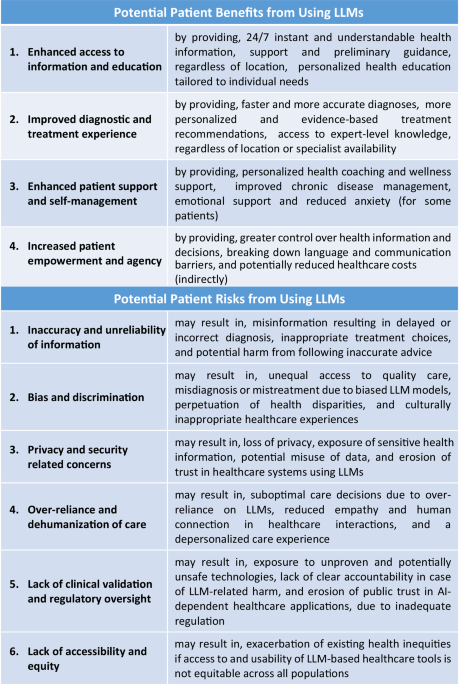
Patient benefits of LLMs
Large language models carry an as yet unknown potential to facilitate the healthcare-involved stakeholders to focus their care around patients’ needs by improving access, engagement, and patient agency. However, LLMs, similar to other AI-based technologies, also present significant challenges associated with patient privacy, security, bias, and accountability that have to be taken into consideration5,6. Because LLMs are able to formulate comprehensible responses to complex inquiries, they offer an opportunity to advance healthcare delivery in all health- and digitally-literate patients worldwide, irrespective of where they live and their social determinants of health.
Enhancing access to care
Large language models have opened a new window into a vast landscape of new possibilities regarding the quality of care that patients can access and how they access it. LLMs can simplify the description of medical conditions, assist in drafting medical documents, create training programs and processes, and streamline research processes, and may potentially transform healthcare by enhancing diagnostics, medical writing, education, and project management7,8.
Enhancing precision medicine
LLMs offer functionality (e.g., text-to-speech) which may enhance access to care for patients with disabilities, and they can also accurately translate output to languages, thus making healthcare more accessible to individuals and their special needs worldwide.
For many years, clinicians and industrial stakeholders have investigated novel ways to deliver personalized care; however, factors such shortages of clinicians, budget constraints, and over-burdened systems have largely prevented these efforts from achieving these goals. LLMs can analyze large volumes of patient data, such as genetics9,10, lifestyle11, EHR12,13, and medications14,15, and, therefore, they may enhance precision medicine by identifying potential risks, suggest preventive strategies, and develop personalized treatment plans for patients with chronic or rare conditions16.
Promoting patient engagement and outcomes
It has been recognized that increased patient engagement, resulting in patients taking more ownership of their health-related decisions, often leads to better outcomes. Consequently, patients who adopt better adherence to their treatment plans more frequently acquire and attain effective preventive actions, which eventually result in improved short- and long-term outcomes.
LLMs have the transformative potential to be powerful allies in promoting patient engagement17,18. By enhancing personalized patient education, access to understandable medical information, and clinical decision support; by facilitating patient-clinician communication or understanding a consent form; by providing personalized health plans and coaching; by extracting key information from patient or clinician notes; and by empowering self-management, and supporting shared decision-making, LLMs can help create a more patient-centered, proactive, and equitable healthcare experience. However, responsible development, ethical implementation, and a focus on human connection are crucial to realizing these benefits and ensuring that LLMs truly empower and engage patients in their care.
Promoting patient agency in shared decision-making
Patient agency refers to “the abilities and capabilities of patients to act, contribute, influence, and make decisions about their healthcare”19. It depends on both the readiness and inclination of patients to take part in care decisions, and the barriers sustained by healthcare providers, as well as traditional services and systems, that limit such engagement19. Shared decision-making involves a concerted practice that includes a patient and her healthcare team working together to reach joint decisions, which are based on the patient’s informed preferences and clinical evidence19.
Despite increased appreciation of the significance of health-literacy at a policy and global level20,21, and given that the practice of medicine today is more patient-centered than in the past, many clinicians believe that it is the patients’ responsibility to improve health literacy rather than the responsibility of the clinician to adapt their communication and educational methods to the different health-literacy levels and needs of their patients. A cofounding of this situation is the confusion regarding health- and digital-literacy, which, while they are related, they are intrinsically different.
In the dawn of today’s worldwide digital transformation22, the generally accepted assumption has been that digitally-literate people are also health-literate; however, while digital literacy is a valuable asset and contributing factor to health literacy in today’s digital age, it is not a guarantee or direct substitute for health literacy. Being digitally literate makes it easier to access health information, but it does not automatically ensure someone can understand, evaluate, and apply that information effectively in a health context23.
While digital technologies have enabled and facilitated increased access to health-information and healthcare applications, not all individuals will have the knowledge or the capacity to access them effectively24. Thus, for health-literacy to be achieved, patients not only need accurate information they can trust, but they also need sufficient skills to identify accurate and reliable sources of information within the enormous available array of resources to which they are now exposed through LLMs.
Thus, one can frame the patient-centered changes empowered by LLMs in terms of: (i) values and preferences–patients may prioritize certain outcomes or aspects of care differently than clinicians (e.g., quality of life vs. longevity, natural remedies vs. aggressive interventions); (ii) understanding of their condition–they have done their research, formed opinions, and have specific needs and questions; and (iii) practical limitations–they might have constraints related to lifestyle, finances, time, social support, or personal beliefs that impact their ability to adhere to certain treatment plans; a patient might intellectually understand and even agree with a plan, but practically, it might be very difficult for them to adopt and implement it, in their daily life.
As patients become increasingly more health-literate worldwide, it appears that there will be a need for compromise between an LLM’s optimal clinical care (or from a medical perspective, best course of action), and what patients feel they need and are able to achieve that will be dependent on the level of risk a patient is willing to accept, as well as the severity of the illness. Eventually, improved awareness of a patient’s health should facilitate and enhance more effective communication and more fruitful engagement with the patient’s clinicians. At the systems level, relevant infrastructures and processes also need to be in place to support such a system (comprised of health-literate physicians, specialists, and other health care providers).
Promoting patient agency in individual decision-making
While improving health literacy has been a stated objective20,21, there are aspects of health-literacy, such as the understanding of risk and benefit, needed in a discussion of treatment choices and the resulting decision-making that may not always be feasible or even available.
Eventually, improved patient levels of health-literacy result in a better understanding of their disease and the available types of treatment, and render them better equipped to care for themselves, even if they are not able to have immediate access to therapies from which they could benefit. Assuming broad-band internet access exists, such benefits could be realized in remote areas, for example, in Africa, Central and South-East Asia, Central and Latin America, where the under-resourced medical systems and the remoteness of some areas may force people to prioritize resources and travel, in order to see a specialist.
In conclusion, given that LLMs offer a real and growing capacity for health-education, knowledge, and competency that could advance patient empowerment and agency, their integration and adoption by healthcare services and structures could minimize patient- or physician-driven medical errors (Box 1). While patients are becoming the drivers of this transformation, such a process will require their participation, worldwide, in leading roles in determining strategy, making policy and governance, and in building and sharing practices and evidence such that patient empowerment and engagement become broader and deeper at all levels (i.e., education, research, care, regulation, governance, etc.).

link